Key takeaways
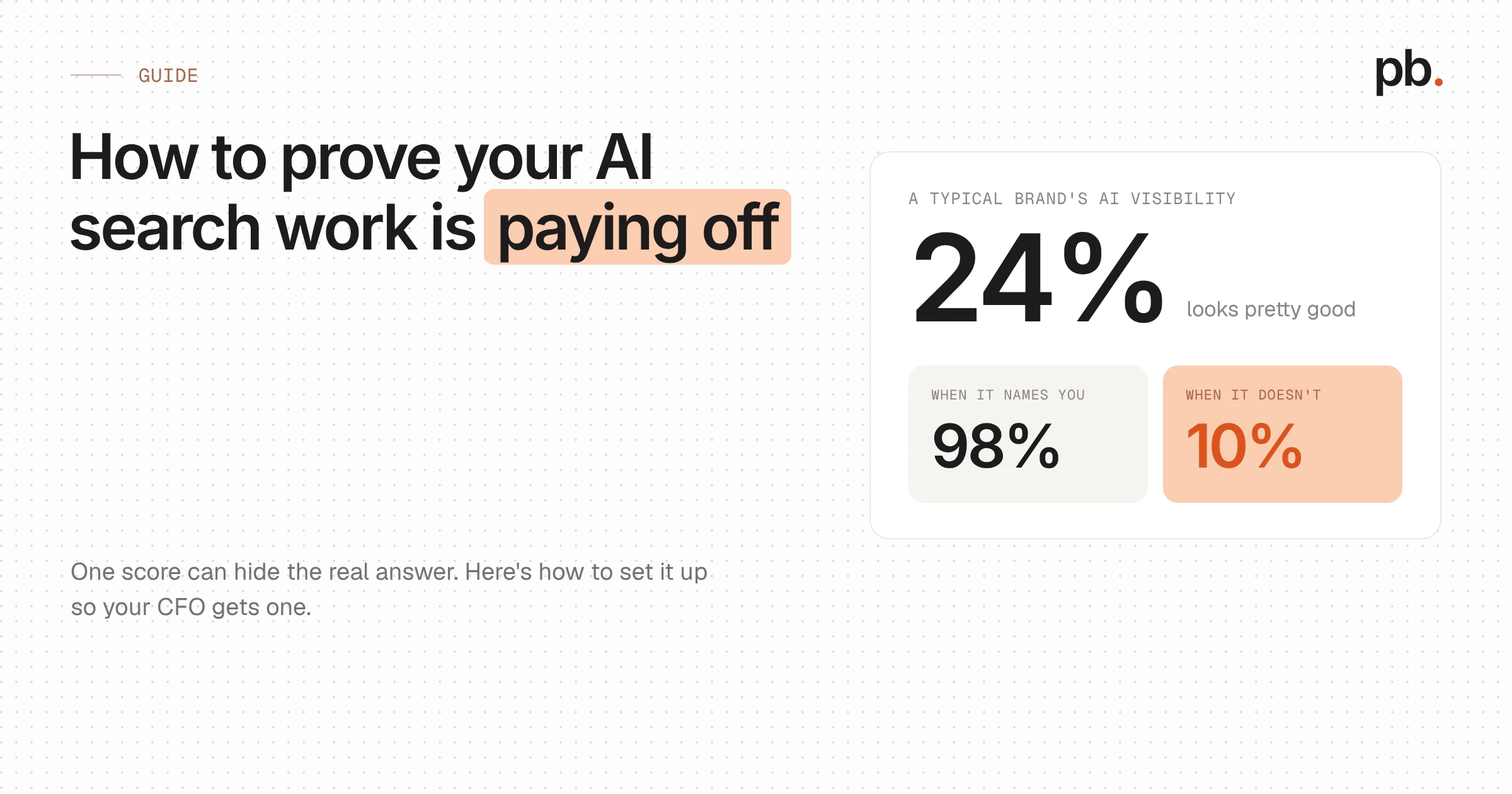
- In our data, a typical brand shows up in about 98% of AI answers when the question has its name in it, and about 10% when it doesn’t. Mixed together, that’s a score of about 24%.
- So one blended visibility score can make you look a lot better than you’re doing with people who don’t know you yet.
- Pick one goal first: new buyers in one segment, or deals your sales team is already working. Then track the questions for that goal on their own.
- Bring your CFO the buyers you’re winning, what you did to win them, and the before and after on those questions only.
Pretty soon someone’s going to ask if your AI search work is bringing in new buyers or just helping close the ones who were already coming. I wanted to see how much one visibility score would actually tell you, so we pulled our data.
This is the setup I’d use so you have a real answer when your CFO asks. I also put it in a 10-page guide on LinkedIn if you’d rather save the slides.
The question you’re going to get
“Is AI search bringing us new buyers, or just helping us close the ones who were already coming?”
“Our visibility went up” won’t be enough of an answer. You need to say which buyers you’re going after, and show you’re winning those questions.
One score can make you look better than you are
Questions that already have your name in them almost always mention you. If someone asks “Is Acme worth it?”, the answer is going to talk about Acme. Mix those questions in with everything else and your score climbs.
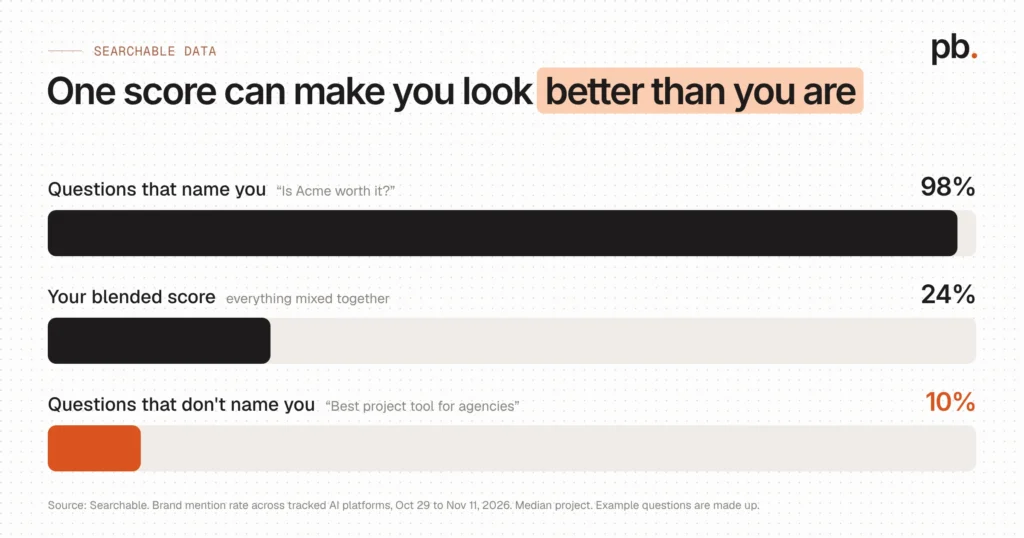
For a typical brand in our data, only about 1 in 8 tracked questions names it. That’s still enough to more than double the score. So a 24% can look pretty good when the number that matters for new buyers is closer to 10%.
Pick one goal before you spend
Both of these are fine goals. They just need different questions and different proof.
- Find new buyers. Show up for people who don’t know you yet, in one segment you pick on purpose. Proof: more new pipeline from that segment.
- Help close deals. Look good when buyers already talking to your sales team check you out in AI. Proof: deals in play close more often or faster.
You can go after both. Just don’t measure them together.
Each goal lives in different questions
Brackets are where your own details go.
Find new buyers (no brand name in the question):
- How do I fix [problem]?
- Best [category] for [audience]
- What should I look for in a [category]?
- Is [category] worth it for [type of company]?
- [Category] options in [city]
Help close deals (your name or a competitor’s is in the question):
- [Brand] vs [competitor]
- Is [brand] worth it?
- [Brand] pricing
- [Brand] reviews
- Alternatives to [brand]
Finding new buyers is the hard part
We also looked at how often a typical brand shows up on questions that don’t name it, based on where the buyer is.
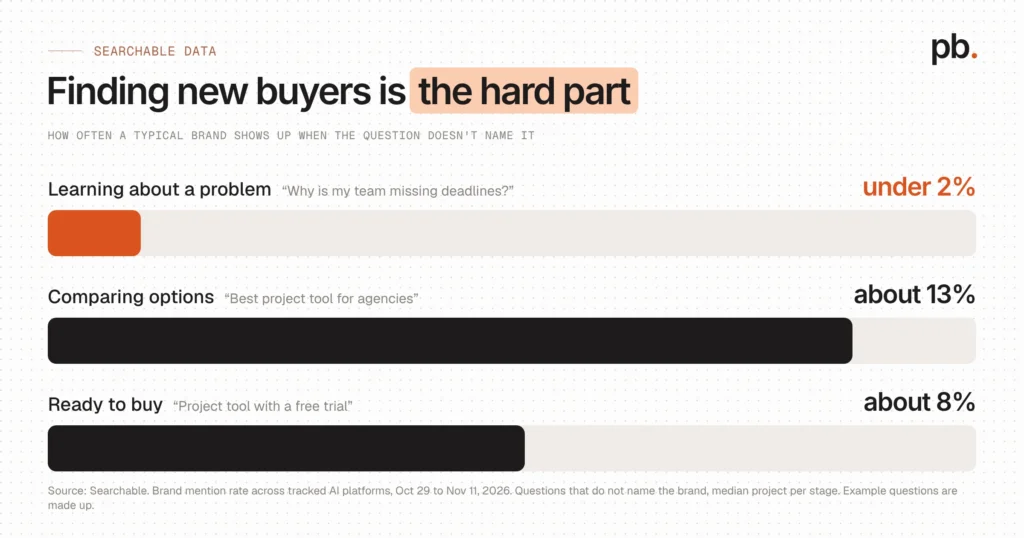
When someone is still learning about a problem, the typical brand shows up in under 2% of answers. It’s about 13% when they’re comparing options and about 8% when they’re ready to buy.
If your goal is new buyers, those early questions are where most of the room is, and where you’ll have the most to show if you win them.
Sort your questions in an afternoon
- Pull 30 to 50 real buyer questions from sales calls, support tickets, Search Console and the forums your buyers use.
- Tag each one by goal: new buyer (no brand name) or active deal (your name or a competitor’s).
- Tag where the buyer is: learning about the problem, comparing options, or ready to buy.
- Cut anything nobody would type. If a buyer wouldn’t ask it that way, it won’t tell you much.
If you need a starting list, I put together 50 fill-in-the-blank prompts you can run on your own brand.
Give each goal its own numbers
Find new buyers
- How often you show up on questions that don’t name you
- Branded searches for you in Search Console
- An AI option on your “how did you hear about us” form
- New pipeline from the segment you picked
Help close deals
- How often you come out ahead on “vs” and “alternatives” questions
- Whether AI gets your pricing and features right
- Buyers who say they used AI to check you out
- Close rate and time to close on those deals
Write down where each number is today, before you change anything.
What to bring to your CFO
- Which buyers you’re winning: the segment or the deals, and the exact questions they ask.
- What you did to win them: the pages, reviews, articles and mentions you worked on.
- The numbers on those questions: before and after, for that goal only.
- What you’d change for the other goal, so they can pick the mix instead of judging one score.
This week’s checklist
- Pick one goal: new buyers in one segment, or deals already in play.
- Pull 30 to 50 real buyer questions (not ones your team made up in a meeting).
- Tag each one by goal and by stage: learning, comparing or ready to buy.
- Write down today’s numbers for each group, separately. Never blended.
- Add an AI option to your lead form’s “How did you hear about us?”
- Check back in 30 days and bring the before and after to your next review.
None of this makes AI search easy to measure. It’s still early and the numbers move a lot. But it’s a lot easier to defend when you can show the exact buyers you’re winning. If you want the bigger picture on what to work on first, start here.
About the data
I work at Searchable, and the numbers in this post come from Searchable data. They’re the brand mention rate across tracked AI platforms from October 29 to November 11, 2026, for the median project, counting projects with enough answers to both kinds of question. “Names you” means the question itself included the brand name. The data covers every tracked project, which likely includes some pitch projects I couldn’t filter out. With this many projects, I wouldn’t expect that to move the median much.
Thanks to Kaleigh Moore, whose piece on proving AEO got me thinking about this.
Sources
- Searchable analysis of brand mention rates across tracked AI platforms, October 29 to November 11, 2026. Median project. Example questions are made up.
- Kaleigh Moore: How to answer “Is AEO helping drive leads and sales?”