Key takeaways
- Start by saying what you sell in 3 to 5 plain words. Everything else builds on it.
- Track the questions new buyers ask (no brand name in them), and go deep: 50 or more per topic.
- Your own site matters more than it did. ChatGPT now checks brands’ own sites by name.
- Then get mentioned on the sites AI already cites for those questions. Don’t bet on one platform.
I get asked where to start with AI search a lot. Most people jump straight to tactics (llms.txt, schema, Reddit threads). The order matters more than the tactic.
Here’s the order I’d go in. It’s the same order we walk agencies through at Searchable, where I work. Six steps, with the data behind each one.
What you’re actually going for
AI search (you’ll also see it called AEO or GEO) is getting AI tools like ChatGPT, Gemini, Perplexity and Google’s AI Overviews to name your brand and link to your site when people ask questions.
There are two wins:
- A mention. The AI names your brand in its answer.
- A citation. The AI links to your page as a source. Citations are what send people to your site.
It doesn’t replace SEO. It builds on it. Most AI tools run web searches before they answer, so pages that are easy to find and easy to read still win.
How an AI answer gets built
When you ask ChatGPT something that needs current information, it breaks your question into several smaller searches (this is called query fan-out). It reads a bunch of pages from those searches. Then it names a few brands and cites a few pages.
A few numbers on how that works today:
- Since August 8, 2026, ChatGPT shows about 22.5 pages consulted per answer, up from 11.6. That’s across 5,000+ brands (Searchable).
- It retrieves about 6x as many pages as it cites. 85% of the pages it pulls never get cited (AirOps).
- About a third of cited pages came from fan-out searches, and 95% of those searches had zero search volume (AirOps).
So being read isn’t enough. Your page has to be the clearest answer out of everything the AI opens. And keyword tools won’t show you most of the searches the AI actually runs.
The six steps, in order
Each step builds on the one before it, so don’t skip ahead.
Step 1: Say what you sell in 3 to 5 words
AI tools and search engines file every business under a simple description. If yours is vague, they guess. Guesses lead to wrong answers about you.
Write a plain description with no marketing language:
| Brand | What they sell |
|---|---|
| Gymshark | Gym wear |
| ClickUp | Project management software |
| Ferrari | Italian sports cars |
- Put that description in your homepage H1, page title and meta description.
- Make every main menu category sit clearly under it.
- Check it: search your brand on Google. The label under your name is how Google describes you today.
Step 2: Pick your categories and real competitors
Your description tells you who you actually compete with. Not everyone in your industry is a competitor.
- List your top 5 categories. Your site menu is a good place to start.
- Name 3 main competitors, plus 1 or 2 for each category.
- Sort each category into one of three goals: Protect (you already show up), Expand (you’re close), or Capture (competitors win today).
- Start with what actually makes money and what season is coming up.
Step 3: Track the questions buyers actually ask
These are your prompts. You’ll track them every day, so this step decides whether your data means anything.
| Stage | Example prompt |
|---|---|
| Learn | what is a CRM and do I need one |
| Consider | best CRM for a 10 person sales team |
| Purchase | HubSpot vs Pipedrive pricing |
- Use unbranded prompts (no brand name in them). Branded prompts make your score look great and tell you nothing about new buyers.
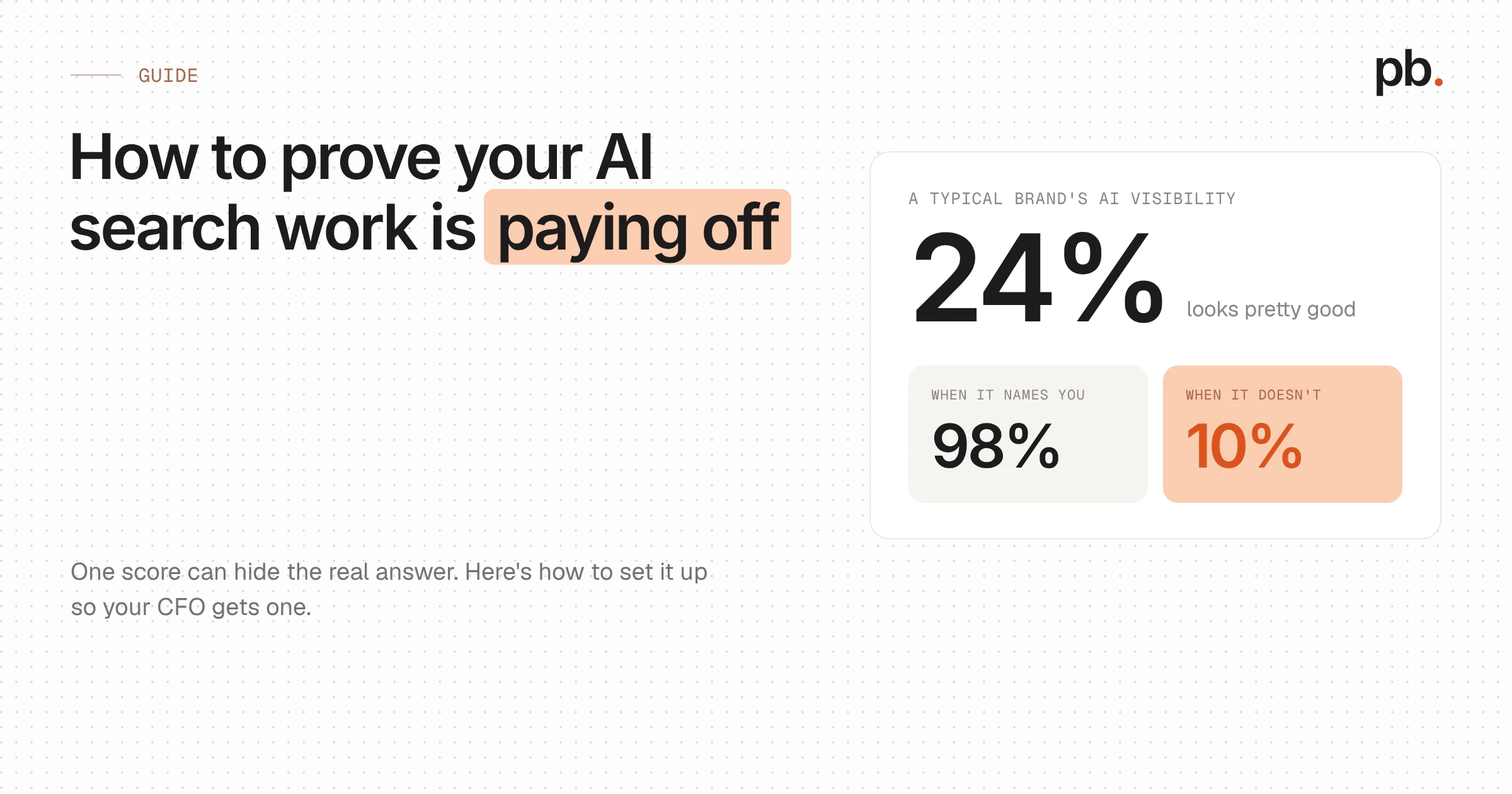
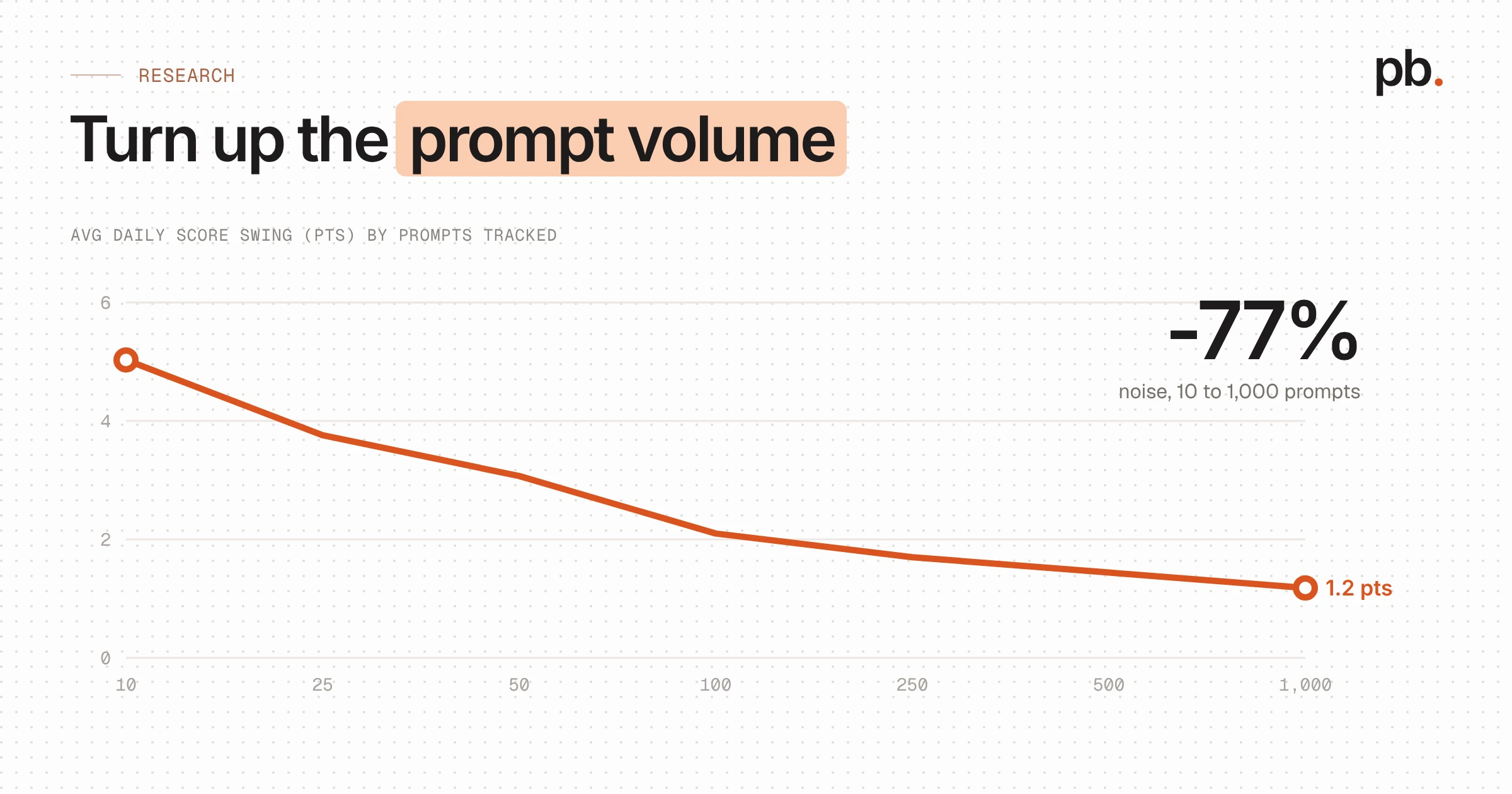
- Go deep before wide. Aim for 50 to 75 prompts per topic. A few prompts per topic is just noise.
- Start with 3 topics. A few topics done deeply beats a lot done thinly.
- Put more prompts where the revenue is. Don’t split them evenly (purchase prompts matter, since about 1 in 5 US checkouts now has AI use in the day before).
- Pick which AI models to track based on who you sell to. I broke that down here.
Step 4: Connect your data and let AI crawlers in
- Connect Google Search Console and Google Analytics 4 on day one. Add Bing Webmaster Tools too, and Google Merchant Center if you sell products.
- Check that your robots.txt, CDN and firewall aren’t blocking AI crawlers like GPTBot, OAI-SearchBot, ClaudeBot and PerplexityBot. A lot of security defaults block them.
- Track AI bot visits and AI referral traffic, so you can see which pages they read and which ones send people to you.
Step 5: Make your own site the best answer
This is the step that changed the most this year. After August 8, ChatGPT started searching brands’ own sites by name. About 1 in 8 of its domain-targeted searches now point at the brand’s own site, and 85.9% of brands are getting cited from their own site more often than before (Searchable).
Your site is a source now. Treat it like one.
- Put the answer at the top. 44% of ChatGPT citations come from the first 30% of a page (Kevin Indig).
- Use plain definitions (“X is…”) and write headings as the question people actually ask.
- Put the facts on the page: pricing, specs, who it’s for, locations. AI can’t cite what you don’t publish.
- Don’t lock key info in PDFs, behind forms, or in content that only loads with JavaScript.
- Add original data where you can. Nobody else can be the source for it.
- Update key pages and show the date. One or two good pages a week beats ten thin ones a day.
Step 6: Get mentioned on the sites AI already trusts
For each prompt, look at which websites the AI cites. That list is your outreach plan. Split it in two:
- Owned: page types you can make yourself (guides, comparisons, FAQs). Make them.
- Earned: sites you need to show up on (review sites, industry publications, YouTube, LinkedIn, directories). Get listed, reviewed, quoted or featured.
Reviews matter here. ChatGPT searches review sites like Trustpilot, G2 and Clutch by name when it checks out a brand (Searchable). Ask happy customers for reviews on the ones in your space.
One thing to know: “best X” roundups are worth less than they were. ChatGPT cut listicles from 15.8% of its citations to 7.8% on August 6 (Peec AI data). They still work. Just don’t make them your whole plan.
And don’t build on one platform. Reddit fell from 12.6% of ChatGPT answers to 1.7% in about 48 hours on August 14. Over the same days LinkedIn went up 54% and YouTube went up 58% (Searchable). Sources change fast. Spread your effort.
How to measure it
- Run prompts every day, judge results weekly or monthly. AI answers change from run to run. One day’s result is noise. Trends over weeks are real.
- Set a baseline first. Track for two weeks before you change anything, so you know your normal range.
- Track four numbers: visibility on unbranded prompts, share of voice against competitors, mentions, and citations.
- Watch the gap between mentions and citations. Getting named without a link means the AI knows you but is sourcing someone else.
- Review your prompt list once a month. Keep it stable otherwise. Changing prompts every week breaks your trend line.
Mistakes I see a lot
- Tracking branded prompts. Your score looks high and means very little.
- Too few prompts. A handful per topic gives you random results.
- Reacting to one day of data. Daily swings are mostly noise.
- Marketing language for what you do. “Empowering teams to thrive” tells an AI nothing. “Payroll software” does.
- Blocking AI crawlers by accident. Check your CDN and firewall before anything else.
- Hiding key facts. No pricing or specs on the page means the AI cites someone who has them.
- Mass-producing AI articles. A sudden flood of thin posts looks low quality. Publish steadily.
Your first 30 days
- Week 1: Write what you sell in 3 to 5 words and put it in your homepage H1, title and meta description. Make sure AI crawlers aren’t blocked. Connect Search Console, GA4 and Bing Webmaster Tools.
- Week 2: List your top 5 categories and your real competitors. Write 50+ unbranded prompts for your top 3 topics and start tracking them daily.
- Week 3: Note your unbranded visibility and share of voice. List the sites AI cites for your prompts, split them into owned and earned, and find your 3 weakest high-value prompts.
- Week 4: Rewrite 2 key pages with the answer at the top. Add missing facts. Pitch or list yourself on 3 of the earned sites. Ask 5 happy customers for a review.
TLDR
Say what you sell in plain words. Track the questions new buyers ask, and go deep. Make your own site the clearest answer, since ChatGPT now checks it by name. Then get mentioned on the sites AI already cites for your questions, and spread that across more than one platform. Judge it on weekly trends, not daily swings.
Sources
- Searchable: ChatGPT’s research depth doubled (Aug 2026)
- Search Engine Land: ChatGPT citations favor a small group of domains (AirOps study)
- Search Engine Land: 44% of ChatGPT citations come from the first third of content (Kevin Indig)
- The State of Brand: ChatGPT halved its listicle citations (Peec AI data)
- Searchable AI Search Accelerator sessions (Sep to Oct 2026)