Key takeaways
- 50 fill-in-the-blank prompts that work for any business, split by funnel stage.
- Test like a stranger: a Temporary Chat with personalization off, or a logged-out window.
- Run each prompt 2 or 3 times and log every run as its own row.
- Where you go missing tells you what to fix. The sites AI cites are your to-do list.
I posted these 50 prompts on LinkedIn and a lot of people saved them. A few asked how to actually run it and keep track of the results. So here’s the full experiment, start to finish.
You don’t need a tool for this. You need ChatGPT, a spreadsheet and an afternoon. By the end you’ll know where your brand shows up, where it doesn’t, and what to fix first.
What you need
- ChatGPT (the free version works).
- A spreadsheet. Google Sheets is fine.
- Your six blanks, filled in below.
- About 2 to 3 hours. 50 prompts with 2 or 3 runs each is around 150 answers.
Step 1: Fill in your six blanks
Every prompt uses the same six blanks. Write yours down once, then copy and paste. Here’s an example for a family dentist in Denver.
| Blank | Example | What to put |
|---|---|---|
| [Brand] | Brightside Dental | Your company name |
| [Category] | family dentist | What you sell, in 2 to 3 plain words |
| [Competitor] | Smile Studio | Your main rival (rotate your top 3 over time) |
| [Audience] | parents with young kids | Who buys from you |
| [Problem] | a chipped tooth | What you fix for them |
| [City] | Denver | Only if you sell locally. Skip it if you don’t |
Use the words your buyers use, not your marketing words. If customers call it “payroll software,” don’t write “workforce enablement platform.”
Step 2: Set it up so you test like a stranger
ChatGPT can remember you. If you test from your own account, you’ll get friendlier answers than a new buyer would.
- Use a Temporary Chat with personalization off, or a logged-out window. A Temporary Chat can still use your memories if personalization is on, so turn it off.
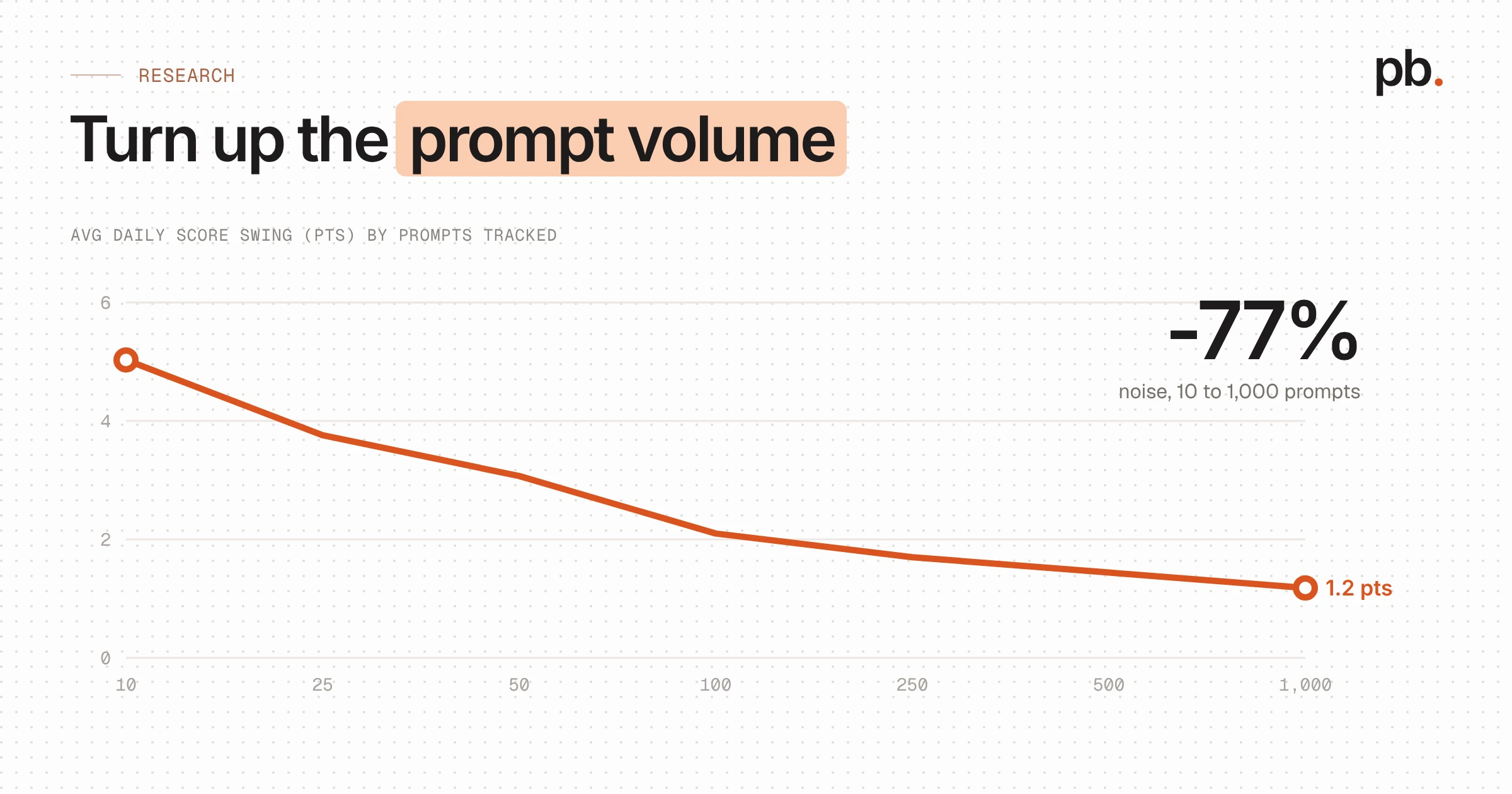
- Run each prompt 2 or 3 times. The answers change from run to run.
- Don’t name your brand in the top of funnel prompts. That’s the whole point. You want to see if AI brings you up on its own.
- Start with ChatGPT. Repeat in Gemini and Perplexity when you can.
Step 3: Run the 50 prompts
Swap in your blanks and paste them in one at a time. They’re split by funnel stage, because where you go missing tells you what to fix.
Top of funnel: when they’re looking for options (1 to 10)
Discovery questions. No brand name. This is where new buyers find you, or don’t.
- What are the best [category] options for [audience]?
- What’s the best [category] in [city]?
- Who are the top 10 [category] companies right now?
- Which [category] do experts recommend?
- What’s the best [category] for beginners?
- What’s the most affordable [category] that’s still good?
- Which premium [category] is actually worth paying for?
- Which [category] brands are growing fastest this year?
- I’m one of the [audience]. What [category] should I look at?
- What are the most trusted [category] brands?
Top of funnel: when they only know the problem (11 to 20)
They aren’t shopping yet. They’re trying to fix something. Does AI point them to you?
- How do I fix [problem]?
- What’s the fastest way to solve [problem]?
- Why do I keep running into [problem]?
- What tools or services help with [problem]?
- How do [audience] usually handle [problem]?
- Is it worth paying someone to help with [problem]?
- What should I look for in a [category]?
- What should I ask before choosing a [category]?
- How much does a [category] usually cost?
- Do I need a [category], or can I do it myself?
Middle of funnel: when they’re comparing you (21 to 35)
They know your name and your competitors’ names. Who comes out ahead?
- [Brand] vs [Competitor]: which is better?
- What are the best alternatives to [Competitor]?
- What are the best alternatives to [Brand]?
- Compare [Brand], [Competitor] and others for [audience]
- Which is better for [audience], [Brand] or [Competitor]?
- What are the pros and cons of [Brand]?
- What’s the difference between [Brand] and [Competitor]?
- Is [Brand] cheaper than [Competitor]?
- Which [category] has the best customer service?
- Which [category] is easiest to get started with?
- [Competitor] is too expensive. What should I use instead?
- Who are [Brand]‘s main competitors?
- Which [category] do most [audience] switch to?
- What’s the best [category] for [problem]?
- Rank the top 5 [category] options for [audience]
Bottom of funnel: when they’re about to buy (36 to 50)
They’re checking you out. Is what AI says about you right, current and fair? This stage matters more than it looks (about 1 in 5 US checkouts now has AI use in the 24 hours before).
- What is [Brand] known for?
- What does [Brand] do?
- Is [Brand] worth it?
- Is [Brand] legit?
- What do people on Reddit say about [Brand]?
- What are the most common complaints about [Brand]?
- What do reviews say about [Brand]?
- How much does [Brand] cost?
- Who is [Brand] best for?
- Who should not use [Brand]?
- Is [Brand] a good fit for [audience]?
- Does [Brand] offer a free trial or guarantee?
- How long has [Brand] been around?
- Should I go with [Brand] or [Competitor]?
- Is [Brand] still a good choice this year?
Step 4: Score every answer
Check the same four things for every answer.
- Mentioned: were you named at all? Yes or no.
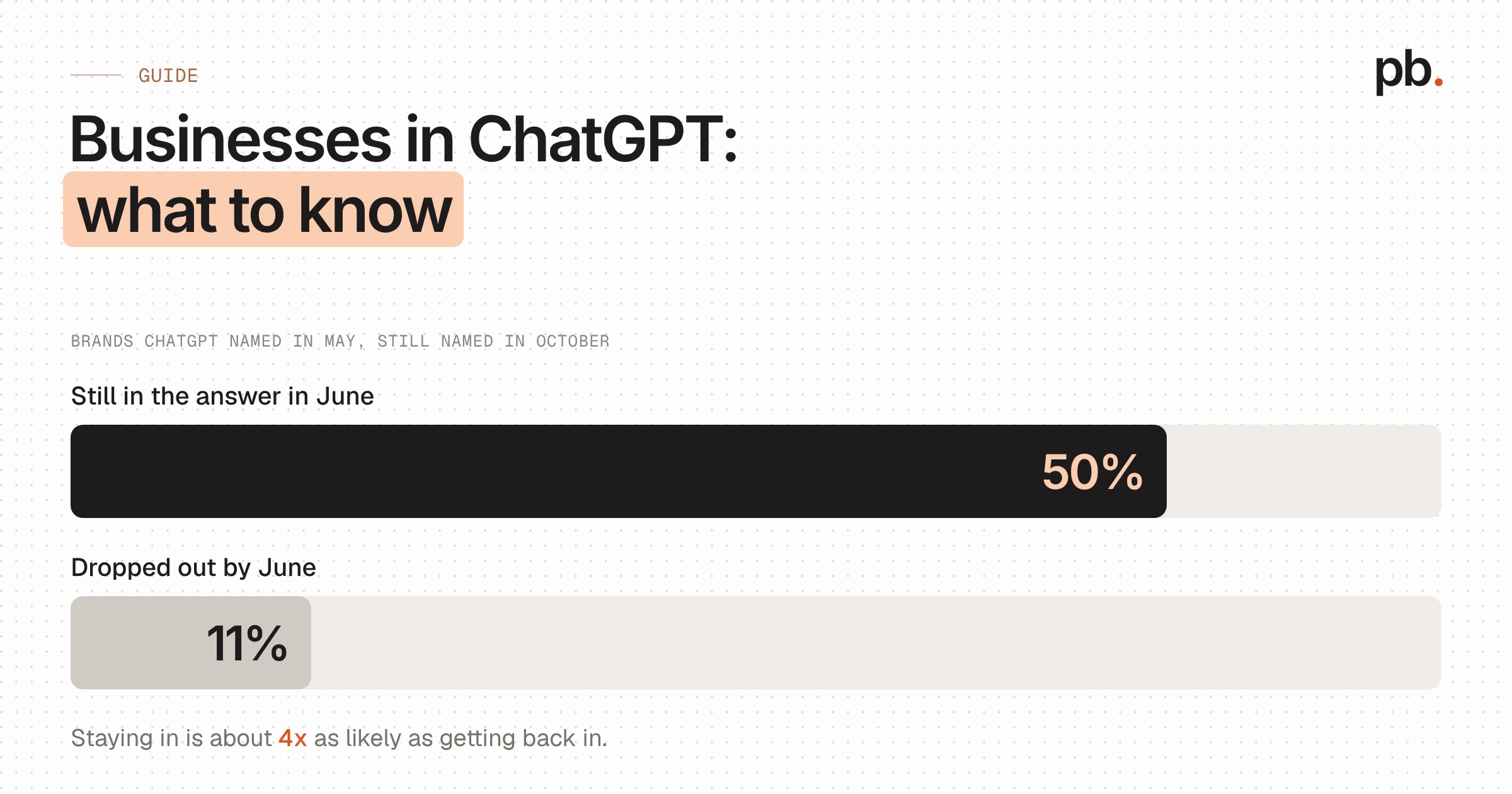
- Position: where in the list? Higher is better. Brands ChatGPT names first were still named for the same question 7 weeks later 79% of the time. Brands named 6th to 10th, only 37%. (Full data here.)
- Accuracy: was it right? Prices, what you do, who you serve, where you are.
- Sources: which sites got cited? Write down every link.
Log each run as its own row, not one cell per prompt. If you only keep the last answer, you can’t tell a real change from the answers just moving around. Set your sheet up like this:
| Prompt # | Run | Mentioned? | Position | Right? | Sites cited |
|---|---|---|---|---|---|
| 1 | 1 | No | – | – | yelp.com, healthgrades.com |
| 1 | 2 | Yes | 4th | Yes | yelp.com, a local “best of” list |
| 1 | 3 | No | – | – | healthgrades.com |
One more thing when you count. AI might name you as your brand, your domain or a slightly wrong spelling. Count all of those as the same mention, or your numbers will move when nothing changed.
Step 5: Read your results
Add up how often you were mentioned in each stage. Then look at where you go missing.
| Where you go missing | What it means | What to fix |
|---|---|---|
| Top of funnel | AI doesn’t know you’re an option | Publish pages that answer the buyer’s question in the first lines. Get onto the “best of” lists and sites AI already cites. |
| Middle of funnel | Someone else is telling your story | Write your own honest comparison pages. Make your differences easy to find. |
| Bottom of funnel | AI has old or wrong facts | Put pricing, who you serve and locations on your site. Clean up your review profiles and old listings. |
Fix the top first. If AI never names you to new buyers, the rest of the funnel never gets a chance.
The sources column is your to-do list. The sites AI cites are the sites you need to be on. Sort them by how often they show up and start at the top.
If you want the full order I’d work in, I wrote it up here: What to focus on in AI search, in order.
Step 6: Run it again in a month
Same prompts, same blanks, same setup. Compare the two sheets. Look at how often you show up across all your runs, not whether you showed up once.
When you’re ready to go past ChatGPT, here’s which AI models your brand should actually track.
If you already use a tracking tool
You’re covered. A tool runs these prompts on repeat for you, across more than one AI model. That’s how we do it at Searchable. The manual version is for anyone who doesn’t have a tool yet, or wants to see it for themselves first.
TLDR
Fill in six blanks. Run 50 prompts as a stranger, 2 or 3 times each. Log every run, then check if you were mentioned, where, if it was right and which sites got cited. Where you go missing tells you what to fix first, and the cited sites are your plan.