Key takeaways
- AI does lean toward fresher content (Ahrefs, AirOps), but the average cited page is still almost 3 years old.
- I couldn’t find a study or method behind “4.3x,” “13 weeks” or “3.2x.”
- Refresh important pages with real changes, and check a stat’s source before you repeat it.
If you work in AI search, you’ve seen these numbers. Content updated in the last 30 days gets 3.2x more AI citations. Half of AI citations are under 13 weeks old. Fresh content gets 4.3x more citations.
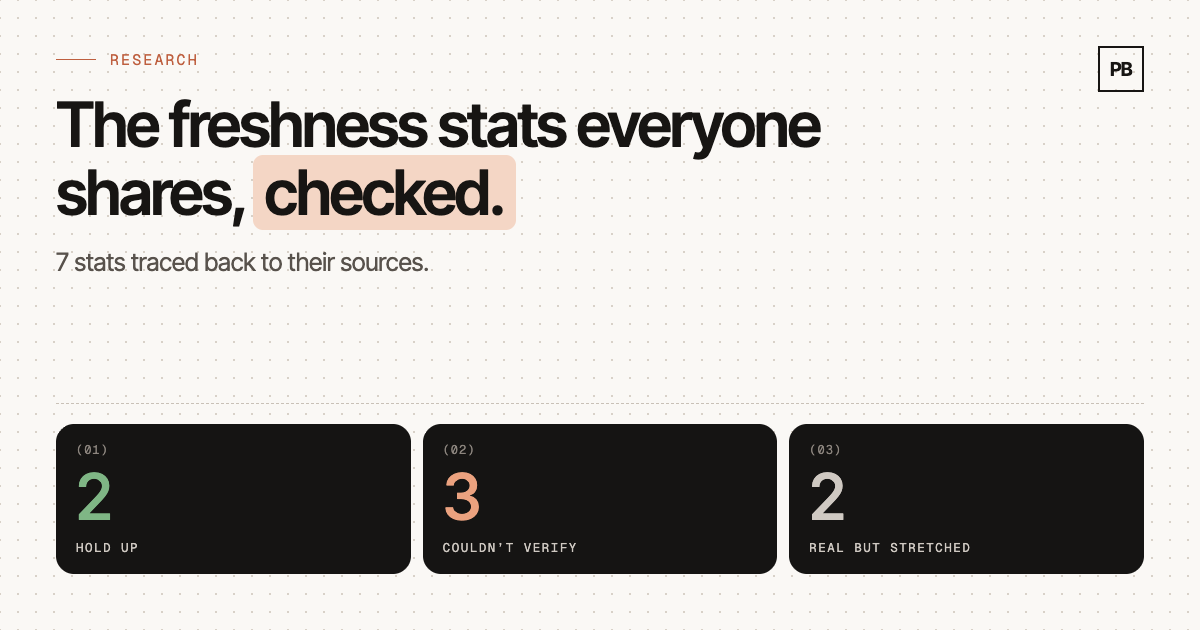
I use stats like these on calls and in posts, so I went looking for where each one actually came from. Some hold up. Some I couldn’t trace to any study at all. A few are real but get stretched way past what the research found.
Here’s what I found.
The ones that hold up
Two stats have a real study behind them, with the method written down.
AI cites content that’s 25.7% fresher than Google. This comes from Ahrefs. They pulled about 17 million cited URLs from ChatGPT, Perplexity, Gemini, Copilot and AI Overviews (July 2025) and compared the age of what each one cited against Google’s regular results. ChatGPT leaned newest. AI Overviews actually cited slightly older pages than Google did.
One thing people leave out: the average AI-cited page in that study was still about 1,064 days old. That’s almost three years. “Fresher than Google” is not the same as “fresh.”
Pages not updated in 3 months are 3x more likely to lose citations. This one is from the AirOps 2026 State of AI Search report, built with Kevin Indig and published in December 2025. It’s a real report with real numbers. Just keep in mind AirOps sells content refresh software, so they have a reason to find that refreshing matters. (I sell AI search software too, so I’m not throwing stones. It’s just worth knowing who ran the study.)
The ones I couldn’t verify
“Fresh content gets 4.3x more citations.” I couldn’t find a study for this. Digital Applied went looking too and came up empty. The only 4.3x I found was about something else entirely: long pages (20,000+ characters) getting more citations. My guess is it got relabeled somewhere along the way.
“Half of AI citations are under 13 weeks old.” This gets credited to Lily Ray at Amsive. As far as I can tell it comes from a conference talk, not a published dataset. I couldn’t find the underlying data on Amsive’s site. Some posts credit it to Ahrefs instead, which doesn’t fit Ahrefs’ own numbers.
It also doesn’t line up with other data. In a later Ahrefs study, the typical page ChatGPT cited was about 500 days old. If half of citations were under 13 weeks, that number would be closer to 90 days. Maybe Lily’s data is right for her sample. I just can’t check it.
“Content updated in the last 30 days gets 3.2x more citations.” This one does trace back to a vendor, ConvertMate. But the method isn’t published, and their own pages describe the dataset a few different ways (10,000 domains, 10,000 queries, 80 million citations). Other posts credit the same 3.2x to different companies, and some use it to mean something else: that stale pages are 3.2x more likely to lose citations. Same number, different claim.
The ones that are real but get stretched
“65% of AI citations go to content from the last year.” The study is real. Seer Interactive looked at 5,000+ URLs. But they measured AI bot visits from log files, not citations. A bot reading your page and an AI citing your page are two different things. The stat gets repeated as citations all the time.
“Changing your date can move you up 95 spots.” Also a real study, a research paper by Fang and others. They gave seven models a list of 100 passages to rank, then added fake publish dates. Passages with newer dates moved up, some by as many as 95 spots. That’s a lab test on a ranking task, not live ChatGPT. It shows the models have a bias toward newer dates. It doesn’t show that swapping the date on your blog post gets you cited.
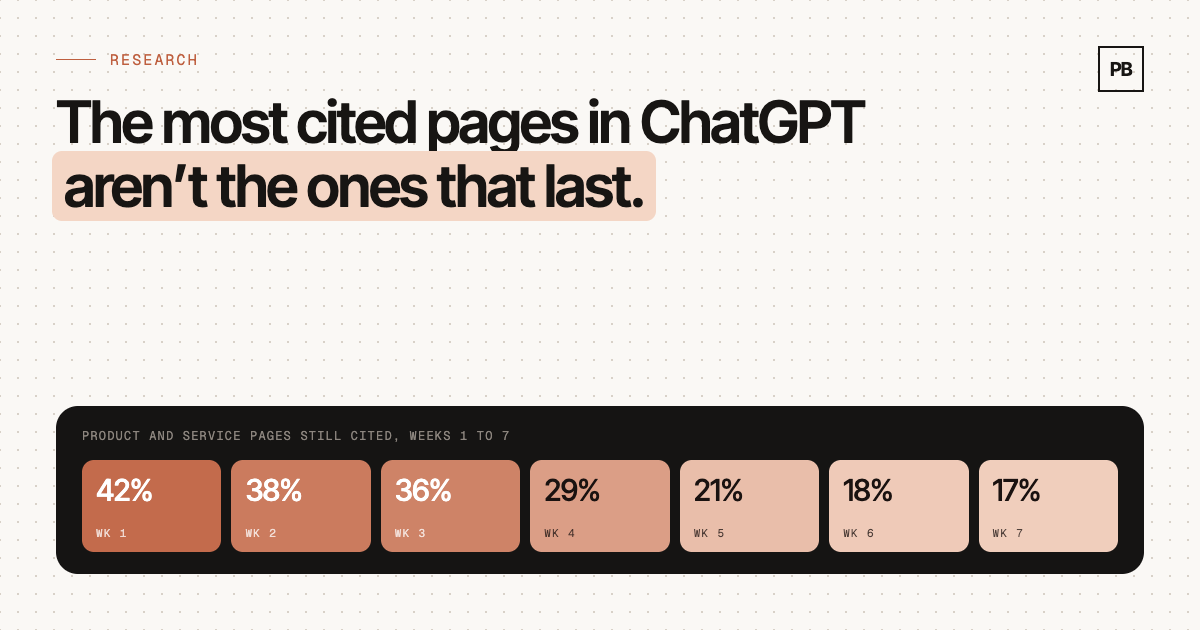
“Fresh wins.” Even the Ahrefs data has a twist here. In their later study, they looked at the pages ChatGPT pulled in for each answer. Among those, the very newest pages often got passed over and the older, more established ones got cited. Freshness helps you get considered. Relevance still decides who gets picked.
What I’d actually do
Freshness matters. The solid data agrees on that. It just doesn’t support a magic number like “update every 30 days or disappear.”
- Refresh the pages that matter on a schedule. Every 3 months is a reasonable default for pages tied to buying decisions (that’s where the AirOps data is strongest). Evergreen explainers can go longer.
- Make real changes. New numbers, new examples, cut what’s outdated. The only date-swap evidence is a lab test, so I wouldn’t bet on it.
- Go faster where the topic moves faster. Pricing, tools and “best of” pages go stale quicker than a definition does.
- Measure your own pages. Track which pages get cited before and after you refresh them. Your own data beats any industry average, including the ones above.
And before you put a stat in a deck or a post, click through to the original. If you can’t find a study, a sample size, or who ran it, don’t use it.
TLDR
AI does lean toward fresher content. The best data shows that clearly (Ahrefs, AirOps). But “4.3x,” “13 weeks” and “3.2x” either have no study I could find or have one with no method behind it. And the Seer and date-swap stats are real but measure something narrower than people claim. Refresh your important pages with real changes, and check every stat before you repeat it.
Sources
- Ahrefs: AI Assistants Prefer to Cite Fresher Content
- Ahrefs: Why ChatGPT Cites One Page Over Another
- AirOps: The 2026 State of AI Search
- Seer Interactive: AI Brand Visibility and Content Recency
- Fang et al.: Do LLMs Favor Recent Content? (arXiv)
- ConvertMate: AI Visibility Study 2026
- ConvertMate: GEO Benchmark Study 2026
- Digital Applied: AI Search Citation Ranking Factors