Key takeaways
- Copilot said something negative about at least one brand in 9.4% of its answers. ChatGPT was 3.0%, and the Google engines were lower.
- Price is where it’s toughest. About 31% of Copilot’s pricing comments were negative, compared with about 20% for ChatGPT.
- It’s harder on integrations and product selection too, about 9% to 10% negative versus 2% or less on the other engines.
- If you only track ChatGPT and Google, you’re not seeing the harshest answers your buyers get.
Copilot is the strictest buyer in AI search. When it compares brands, it’s way more willing to point out what’s wrong with them.
I wanted to know which AI is the hardest on brands, so we took the same buyer questions and asked them on five engines: Copilot, ChatGPT, Google AI Mode, Gemini and Google AI Overviews. We only kept unbranded questions (the ones that don’t name a brand, like asking for the best tool for something), and only compared answers where all five engines got the same question on the same day. Then we checked each answer for at least one negative brand mention.
Copilot calls brands out about 3x as often
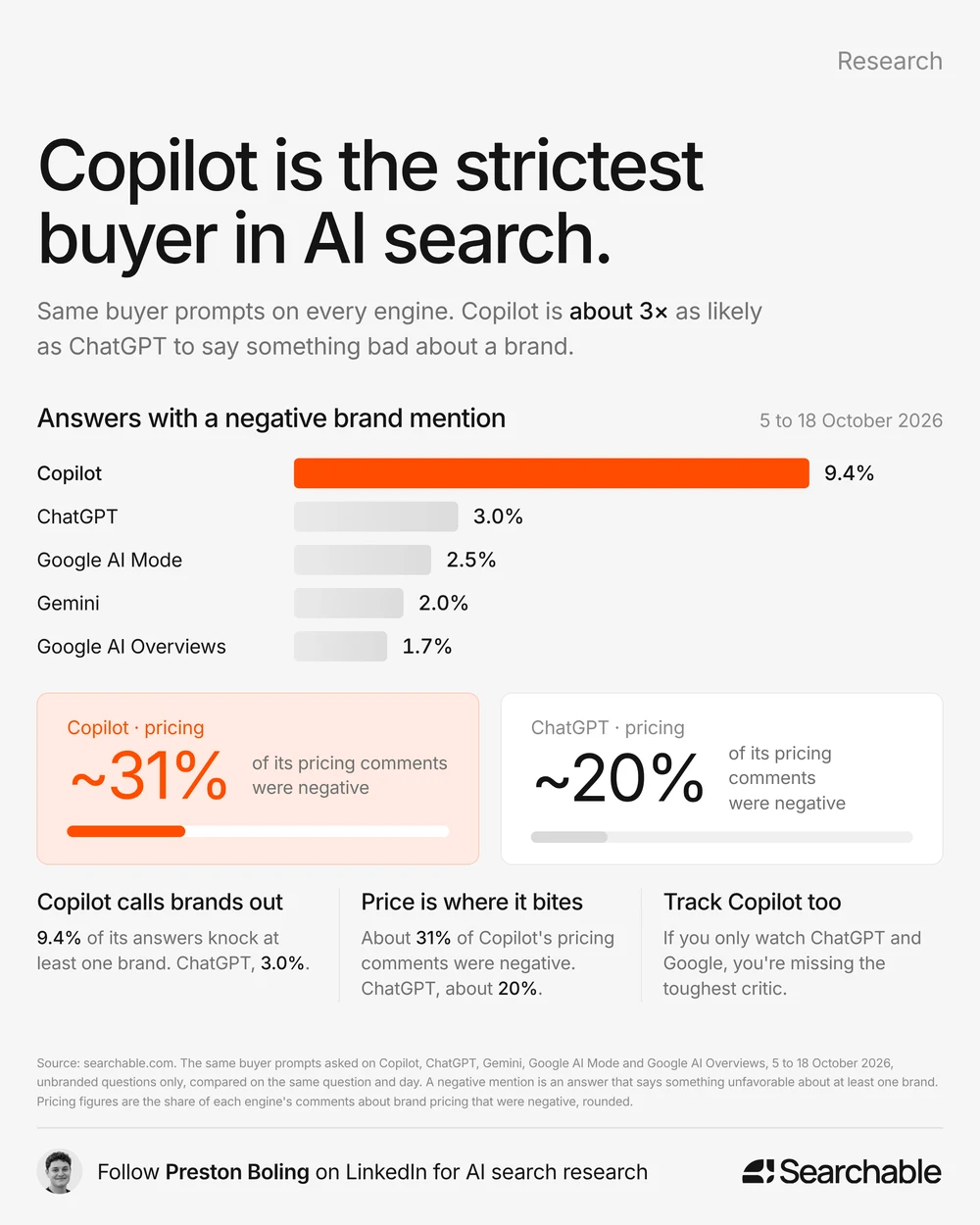
9.4% of Copilot’s answers said something bad about at least one brand. ChatGPT was 3.0%. Google AI Mode was 2.5%, Gemini 2.0% and AI Overviews 1.7%.
It wasn’t one bad day either. Copilot sat around 10% pretty much every day we looked at, while the others stayed between 2% and 3%.
Price is where it bites
When an engine talked about a brand’s pricing, we checked how often that comment was negative. For Copilot it was about 31%. ChatGPT was about 20%, Gemini about 15%, Google AI Mode about 13% and AI Overviews about 10%.
And it’s not only price. About 9% of Copilot’s comments on integrations were negative, and about 10% of its comments on product selection. The other engines were at 2% or less on both.
That’s why I call it the strictest buyer. It calls out the price, the missing integrations and the gaps, and puts that right in the answer.
Why it might be this tough
Copilot answers from Bing. Microsoft says it turns your question into a search query, sends it to Bing and builds the answer from what comes back (Microsoft Learn). So whatever Bing finds about you, reviews and comparison pages included, is what Copilot works with. My guess is that’s where a lot of the pricing complaints come from (we didn’t test why, only how often).
Why you should be tracking Copilot
Copilot is where business buyers already work. Microsoft 365 Copilot passed 30 million paid seats in July 2026 (UC Today), up from 20 million in April (No Jitter). If you sell B2B, there’s a good chance someone on the buying committee asks Copilot about you right from the tools they use every day (our data is the public Copilot, so answers at work can look a bit different).
ChatGPT won’t show you this. If you only track ChatGPT, you see 3% negative and think you’re fine, while Copilot is saying something bad about brands about 3x as often.
Bing’s own tools won’t either. The AI Performance report in Bing Webmaster Tools shows which of your pages Copilot cites and for which searches (Practical Ecommerce). It doesn’t show what Copilot actually said about you, so you still have to look at the answers.
What I’d do with this
- Add Copilot to your tracking. Especially if you sell to business buyers. I broke down which AI models your brand should track if you want help picking the rest.
- Read what it says about your price. Pull the Copilot answers that mention your pricing and check if they’re negative, outdated or just wrong.
- Make your pricing easy to find. If your pricing page is vague or hidden, Copilot fills the gap with whatever else Bing finds. That’s my guess, but it’s a cheap fix either way.
- Check the gaps it calls out. If it keeps saying you’re missing an integration or a feature, either the content needs fixing or the product does.
- Set up Bing Webmaster Tools. It takes a couple of minutes if you import your sites from Search Console, and you get the AI Performance report for free.
TLDR
Copilot is about 3x as likely as ChatGPT to say something bad about a brand, and it’s toughest on price. If you’re not tracking Copilot, you’re missing the answers that are hardest on you.
Sources
- Searchable analysis of answers from Copilot, ChatGPT, Gemini, Google AI Mode and Google AI Overviews to the same unbranded buyer questions, compared on the same question and day, October 5 to 18, 2026.
- Microsoft Learn: web search in Microsoft 365 Copilot
- UC Today: Microsoft 365 Copilot passes 30 million paid seats
- No Jitter: Microsoft 365 Copilot hits 20 million paid seats
- Practical Ecommerce: Bing’s AI Performance report