Key takeaways
- For local searches, Claude cites Yelp. ChatGPT cites government licensing pages and the BBB.
- Across 6.7 million AI answers, ChatGPT almost never cites Yelp. Claude’s Yelp habit is mostly a local thing.
- Fix the source each engine already reads. One local SEO plan won’t cover all of them.
- Reviews raise your odds of getting named, but they don’t guarantee a spot.
ChatGPT and Claude cite different sources when someone asks for a local business. Claude leans on Yelp, while ChatGPT leans on government licensing pages and the Better Business Bureau.
So one local SEO plan won’t cover every AI engine. Here’s what a new study found, what Searchable’s data shows across about 6.7 million AI answers (I work at Searchable), and what I’d do about it.
What did the 8ight.AI study find?
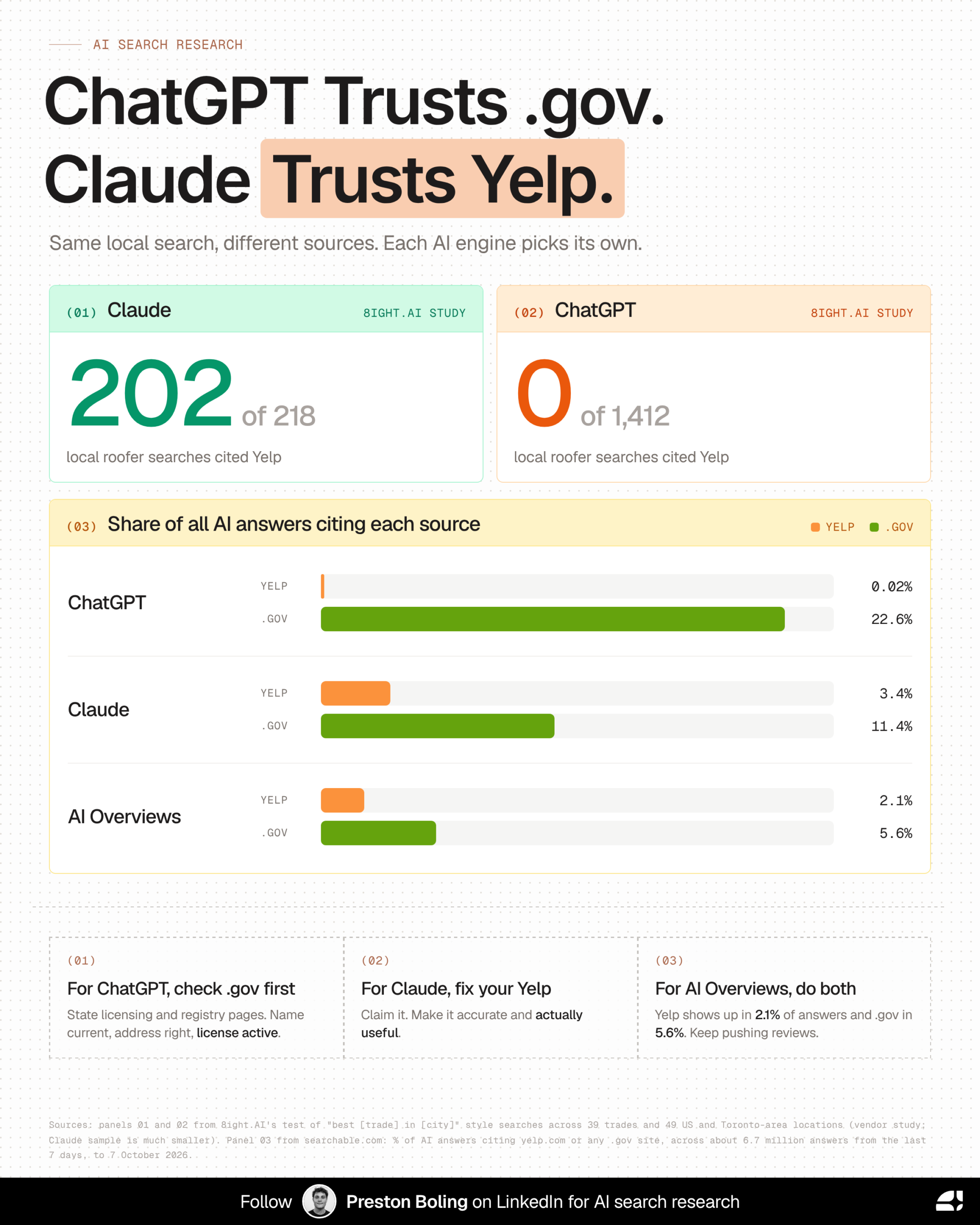
Claude cited Yelp in 93% of its local answers. ChatGPT cited Yelp in none.
8ight.AI asked both engines “Who is the best [trade] in [city]?” across 39 trades and 49 places (32 in the US, 17 around Toronto). The answers came in between September 10 and 30, 2026, and the study came out October 5.
Here’s how the sources split:
| Source | ChatGPT (1,412 answers) | Claude (218 answers) |
|---|---|---|
| Yelp | 0% | 93% (202) |
| Better Business Bureau | 39% | 6% |
| Government or licensing site | 25% | 0% |
| Angi | 12% | 25% |
| HomeGuide | 0.1% | 23% |
| Thumbtack | 4% | 19% |
| 0.4% | 0% |
Most of ChatGPT’s government citations were licensing boards, license look-ups and contractor registries. Claude went almost entirely to directories and review sites.
The engines didn’t agree on the businesses either. For 24% of questions, their two lists had no business in common. And about three in four businesses that got named were named by only one engine.
Does the split hold beyond local searches?
Partly. ChatGPT’s .gov habit shows up everywhere. Claude’s Yelp habit is mostly a local thing.
I pulled Searchable’s data on about 6.7 million AI answers from the 7 days up to October 7, 2026. This covers every kind of question, not just local ones. Here’s the share of answers that cited each source:
| Engine | Yelp | Any .gov site |
|---|---|---|
| ChatGPT | 0.02% | 22.6% |
| Claude | 3.4% | 11.4% |
| AI Overviews | 2.1% | 5.6% |
- ChatGPT almost never cites Yelp, local or not. And it cites a .gov site in more than 1 in 5 answers.
- Claude cites Yelp in only 3.4% of all answers. So the 93% from 8ight.AI is about local searches. When you ask Claude for a local business, it goes to Yelp.
- Google’s AI Overviews sits in the middle. It cites both, just less often.
What should local marketers do for ChatGPT, Claude and AI Overviews?
Fix the source each engine already reads first. Then build out from there.
For ChatGPT, check .gov first
- Look up your business on your state licensing board and contractor registry.
- Make sure your business name is current, your address is right and your license shows active.
- Claim your BBB profile and make sure it matches your site.
For Claude, fix your Yelp
- Claim your Yelp page if you haven’t.
- Make it accurate and actually useful: services, service area, hours and photos.
- Get listed on Angi, HomeGuide and Thumbtack if they cover your trade.
For AI Overviews, do both
- Cover the .gov and Yelp basics above.
- Keep pushing for reviews.
One more for all three: track each engine on its own. A good score in Claude tells you nothing about ChatGPT.
Do review counts matter?
Yes, but they don’t guarantee you a spot.
In the 8ight.AI study, ChatGPT named 3.4% of businesses with fewer than 25 Google reviews. For businesses with 1,000 or more, it was 22.2%. So more reviews helped.
But the business with the most reviews in a city was still left off ChatGPT’s list about three times out of four. And star ratings didn’t help at all. The businesses that got named and the ones that didn’t had the same median rating.
Reviews raise your odds. They don’t replace being on the sources each engine reads.
What are the limits of this data?
Treat this as a strong signal, not a rule.
- 8ight.AI sells AI visibility services. So it has a stake in the topic.
- The Claude sample is small. 218 answers versus 1,412 for ChatGPT, because 8ight.AI’s Claude credits ran out.
- The answers came through each company’s API with web search on, not the consumer apps. What a real person sees can differ.
- A citation is a link shown with the answer. It’s not everything the model read.
- My 6.7 million answers cover one week and every kind of question. It’s also data from Searchable, where I work.
- This could change fast. Yelp licensed its data to OpenAI in July 2026, with Yelp links planned inside ChatGPT. If that rolls out, ChatGPT’s Yelp number won’t stay at zero.
FAQ
Does ChatGPT use Yelp for local recommendations?
Almost never, for now. ChatGPT cited Yelp in 0 of 1,412 local answers in the 8ight.AI study, and in 0.02% of all answers in Searchable’s data. That may change after Yelp’s data deal with OpenAI.
Which sources does Claude cite for local businesses?
Mostly directories. Yelp showed up in 93% of Claude’s local answers. Angi, HomeGuide, Expertise.com and Thumbtack each showed up in about 1 in 5.
Do I need a Reddit strategy for local AI search?
Not based on this data. Reddit was cited 6 times across 1,630 local answers, all by ChatGPT.
How often should I check my local AI visibility?
Weekly. When 8ight.AI asked ChatGPT the same question twice, a median 29% of the businesses named in either answer were named in both. One check can’t tell you much.
Sources
- 8ight.AI: How AI assistants recommend local businesses, a study of 1,630 answers (Oct 5, 2026)
- Searchable: share of AI answers citing yelp.com or any .gov site, about 6.7 million answers, 7 days to Oct 7, 2026
- Let’s Data Science: Yelp licenses local business data to OpenAI (Jul 2026)